
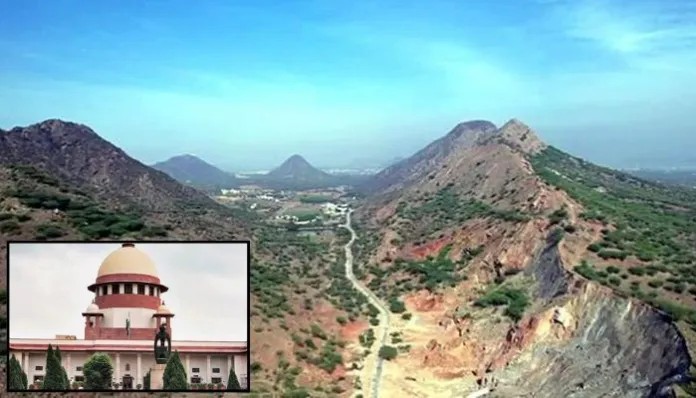
NEW DELHI – In a rare move of judicial self-correction, the Supreme Court of India on Monday (December 29, 2025) stayed its own recent judgment that had redefined the Aravalli Hills. The bench, led by Chief Justice of India (CJI) Surya Kant, put the controversial “100-metre rule” in abeyance following a massive public outcry and warnings from environmentalists that the new definition could lead to the ecological collapse of one of the world’s oldest mountain ranges.
The Controversy: The “100-Metre” FilterThe legal battle centers on a November 20, 2025, ruling where the Court had accepted a definition proposed by a government-led committee. That ruling defined an “Aravalli Hill” as any landform with an elevation of at least 100 metres above the local relief.
Environmentalists argued this was a “death warrant” for the range because:
- Exclusion of Minor Hills: Data suggested that nearly 90% of the hills in the Aravalli range are lower than 100 metres and would have lost their protected status, opening them up to commercial mining and real estate.
- Structural Integrity: The 100-metre threshold ignored the geological reality of the range, which acts as a critical “green wall” preventing the Thar Desert from expanding into the Indo-Gangetic plains.
The Court’s “Suo Motu” Intervention
Taking suo motu cognisance of the widespread criticism, the three-judge bench—including Justices J.K. Maheshwari and A.G. Masih—acknowledged that the previous order required urgent clarification.
”We deem it necessary that the previous Committee recommendations and directions of this Court be kept in abeyance until a fair, impartial, and independent expert opinion is sought,” the CJI remarked during the hearing.
Key Takeaways from the Stay Order
| Feature | Impact of the Stay |
|---|---|
| New Expert Panel | A High-Powered Expert Committee (HPEC) of “domain experts” (not just bureaucrats) will be formed to re-map the range. |
| Mining Status | A complete ban on the grant of new mining leases and renewals remains in force across the Aravalli states. |
| Interim Definition | The court directed states to revert to the Forest Survey of India’s (FSI) 2010 definition, which uses slope and geomorphology rather than just height. |
| Next Hearing | The matter is scheduled for further deliberation on January 21, 2026. |
Political and Public Reaction
The stay has been hailed as a “historic victory” by environmental groups and opposition leaders. In Rajasthan, where mining interests are particularly strong, activists celebrated the move as a lifeline for the state’s shrinking green cover. Union Environment Minister Bhupender Yadav also welcomed the court’s decision, stating that the government is committed to the “protection and restoration” of the range.
The case now shifts to the scientific mapping of the hills, with the Court demanding a “nuanced and measured assessment” that prioritizes ecological function over arbitrary height markers.